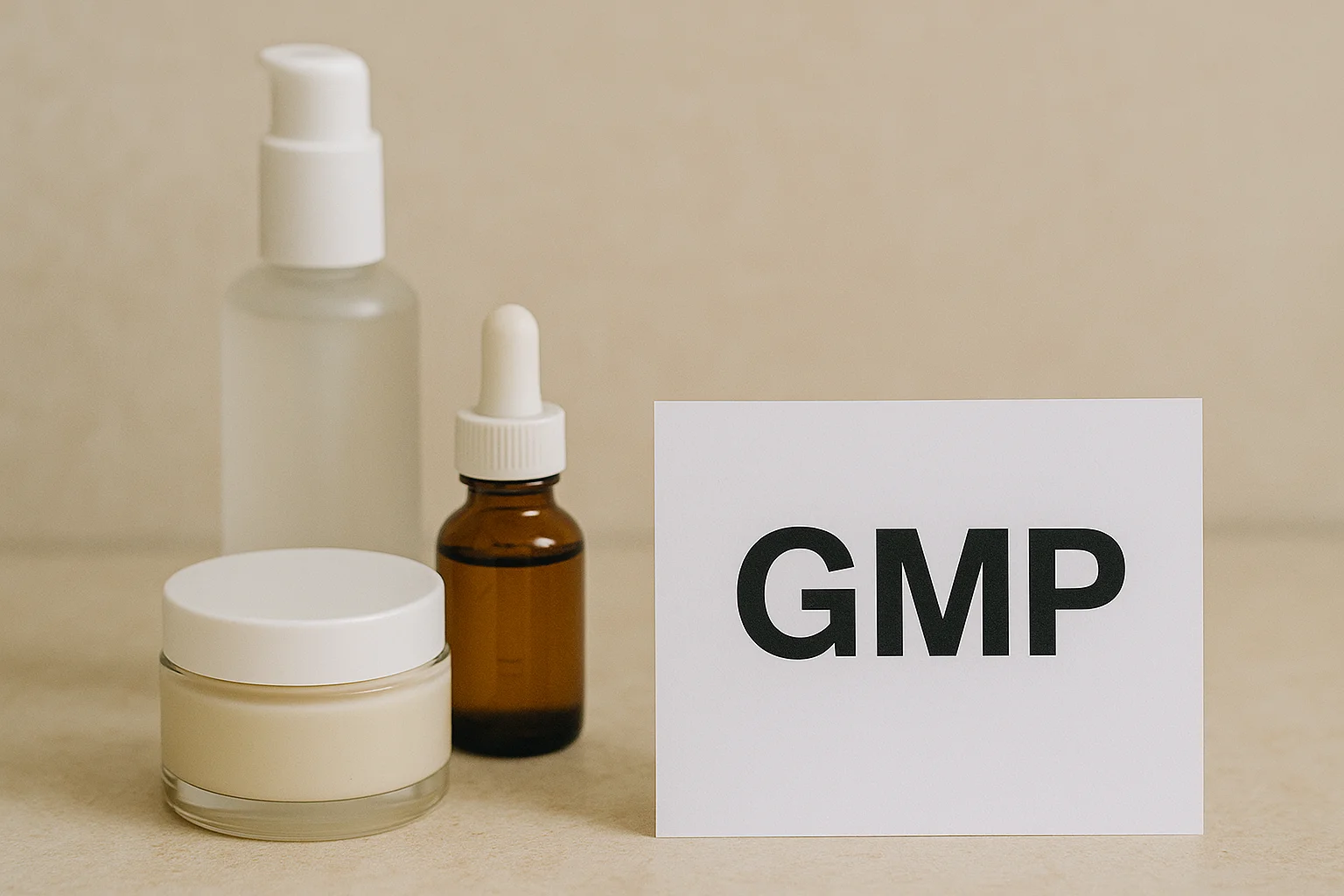
Certifications help skincare makers prove their products are safe and trustworthy. They also make it easier to enter new markets and avoid problems with regulations or product quality.
This article explains three key systems you’ll see in the skincare industry: the CE mark in the EU, FDA rules in the U.S., and GMP standards used worldwide. Understanding these will help you build safer products and grow your brand with confidence.
What Is the CE Mark?

The CE mark (1) means Conformité Européenne or “European Conformity.” It shows that a product meets the EU’s basic safety and health rules.
Products with a CE mark can be sold across the European Economic Area (EEA) (2). It’s not a quality label—just proof that the product follows EU requirements.
CE marking is only needed for products covered by certain EU directives, such as electronics, toys, or medical devices. Most skincare products do not need a CE mark.
Instead, they must follow the EU Cosmetics Regulation (EC) No 1223/2009, which focuses on safety tests, approved ingredients, and proper labeling.
For products that do need CE marking (3), the main steps are simple:
Identify which EU directive applies
Do a conformity assessment
Prepare technical documents
Sign the Declaration of Conformity
These steps confirm the product is safe and meets EU rules.
The manufacturer is responsible for CE compliance, but importers and authorized representatives must also check that products are documented and marked correctly.
A common misunderstanding is thinking all products sold in Europe need a CE mark. In skincare, CE marking applies only in rare cases—such as products with an electronic function. Regular creams, serums, and lotions follow EU cosmetics rules, not CE marking.
What Is FDA Regulation for Cosmetics?

The U.S. Food & Drug Administration (FDA) (4) oversees cosmetic products sold in the United States. Most cosmetics do not need FDA pre-market approval, but they must be:
Safe to use
Not misbranded (labels must be truthful)
Not adulterated (no harmful contamination)
These rules come from the Federal Food, Drug, and Cosmetic Act (FD&C Act), which explains how cosmetics should be made, labeled, and marketed.
The FDA also provides basic GMP guidance for cosmetics to help manufacturers improve product safety. This includes:
Clean manufacturing conditions
Proper labeling
Good record-keeping
Quality control checks
For companies importing or exporting products, FDA rules also cover:
Facility registration
Ingredient safety (5)
Correct labeling for the U.S. market
These steps help ensure that cosmetics entering the U.S. follow federal standards.
What Is GMP (Good Manufacturing Practices) in Cosmetics?

GMP (Good Manufacturing Practices) (6) is a system that helps cosmetic manufacturers keep products safe, clean, and consistent. It focuses on controlling each part of the manufacturing process so every batch meets the same quality standards. GMP also helps brands track materials and production steps, improving traceability.
The main international standard for cosmetic GMP is ISO 22716.
This guideline explains how to manage production, quality control, storage, and product shipment in a safe and organized way.
GMP is especially important in skincare because it helps prevent:
Contamination
Batch-to-batch variation
Loss of consumer trust
Key parts of GMP include:
Clean and well-maintained premises
Trained personnel
Proper equipment
Safe handling of materials
Controlled production steps
Lab testing and quality checks
Accurate records
Complaint handling and recall procedures
GMP certification is not legally required everywhere, but it is often needed for exporting or entering stricter markets.
Many brands choose to follow GMP voluntarily because it shows professionalism and builds trust with buyers.
Step-by-Step Implementation for Skincare Manufacturers
1. Assess Your Current Readiness

Start by reviewing your facility, equipment, and processes. Compare what you have now with the standards required for CE, FDA, and GMP. This helps you identify gaps early and avoid delays later.
2. For the EU Market (CE / EU Compliance)

To sell in the EU, follow the EU Cosmetics Regulation 1223/2009, which requires:
A full safety assessment
A complete Product Information File (PIF)
A designated Responsible Person located in the EU
3. For the U.S. Market (FDA Compliance)

To meet FDA expectations, make sure you:
Register your facility (if needed)
Follow correct labeling rules
Use safe, approved ingredients
Keep clear GMP-related documents
4. For GMP Certification

To meet GMP standards:
Build a GMP quality management system
Train staff and control production workflows
Consider ISO 22716 certification or an external audit
5. Manage Your Supply Chain

Make sure your suppliers and contract manufacturers also meet the required standards. This includes:
Raw material traceability
Verified supplier certifications
Oversight of subcontractor processes
6. Keep Strong Documentation
Good records support safety and compliance. Maintain:
Batch records
Change control logs
Complaint handling forms
Recall procedures
7. Plan Your Market Access Strategy
Match your certifications to the markets you want to enter. Start with the regions that bring the most value, and plan certification steps based on your growth goals.
Ready to Build a Compliant, Market-Ready Skincare Line?
CE, FDA, and GMP standards help skincare brands make safe and reliable products. Each one focuses on a different part of the process, from EU safety rules to U.S. labeling and clean manufacturing. When you understand these requirements and build them into your production steps, it becomes easier to avoid risks, meet market rules, and earn customer trust.

If you need help with CE, FDA, or GMP compliance—or want a trusted partner to support your skincare production—contact us today and start building safer, market-ready products.
FAQs
Does the CE mark guarantee product safety?
No — the CE mark means the manufacturer declares that the product meets applicable EU rules; it does not mean the product was tested or approved by EU authorities.
Do all cosmetic products sold in the U.S. require approval by the U.S. Food & Drug Administration (FDA) before launch?
No — except for color additives and certain special categories, cosmetics typically don’t need FDA pre-market approval, though they must be safe, properly labeled, and not adulterated or misbranded.
Is following ISO 22716 (GMP for cosmetics) legally required everywhere?
Not always. While GMP is a recognized standard and often required for export or certain markets, it may not be mandated in all jurisdictions. However, it is best practice for quality and compliance.
If a product doesn’t require a CE mark, can I still put one on it?
No — CE marking should only be used for products covered by the specific EU directives that require it. Applying it to other products would be misleading and possibly illegal.
What is the difference between a cosmetic and a drug under FDA rules?
The difference lies in the intended use. A product is a cosmetic if its main purpose is cleansing, beautifying, or altering appearance. If it treats or prevents disease or affects the body’s structure/functions, it becomes a drug and must meet stricter regulations.
References for this information:
(1) European Commission, “CE Marking,” Single Market for Goods, 2025.
(2) Eurostat, “Glossary: European Economic Area (EEA),” Statistics Explained, 2025.
(3) Swapsss 株式会社, “CE Regulation in the EU,” Swapsss Blog, 2025.
(4) U.S. Food & Drug Administration (FDA), “Official Website,” 2025.
(5) New Directions Aromatics, “Everything You Should Know About Cosmetic GMP (Good Manufacturing Practices),” Blog, 2025.
(6) Registrar Corp, “GMP for Cosmetics: ISO 22716,” Registrar Corp Blog, 2025.